Community Structure-Regulation Coupling Reveals an Optimal Intervention Domain for Information Diffusion
ByResearch Editorial
COSREF
Multicommunity Networks
Information Diffusion
Community Structure-Regulation Coupling
Optimal Intervention Domain
This article summarizes the Nature Communications paper Community structure-regulation coupling reveals optimal information diffusion. The study introduces COSREF, a framework that reveals three macroscopic diffusion states and their critical phase diagram under the joint action of network structure and regulation parameters, identifies a low-cost domain for containing spreading, and finds a nonmonotonic dependence between optimal intervention cost and community strength.
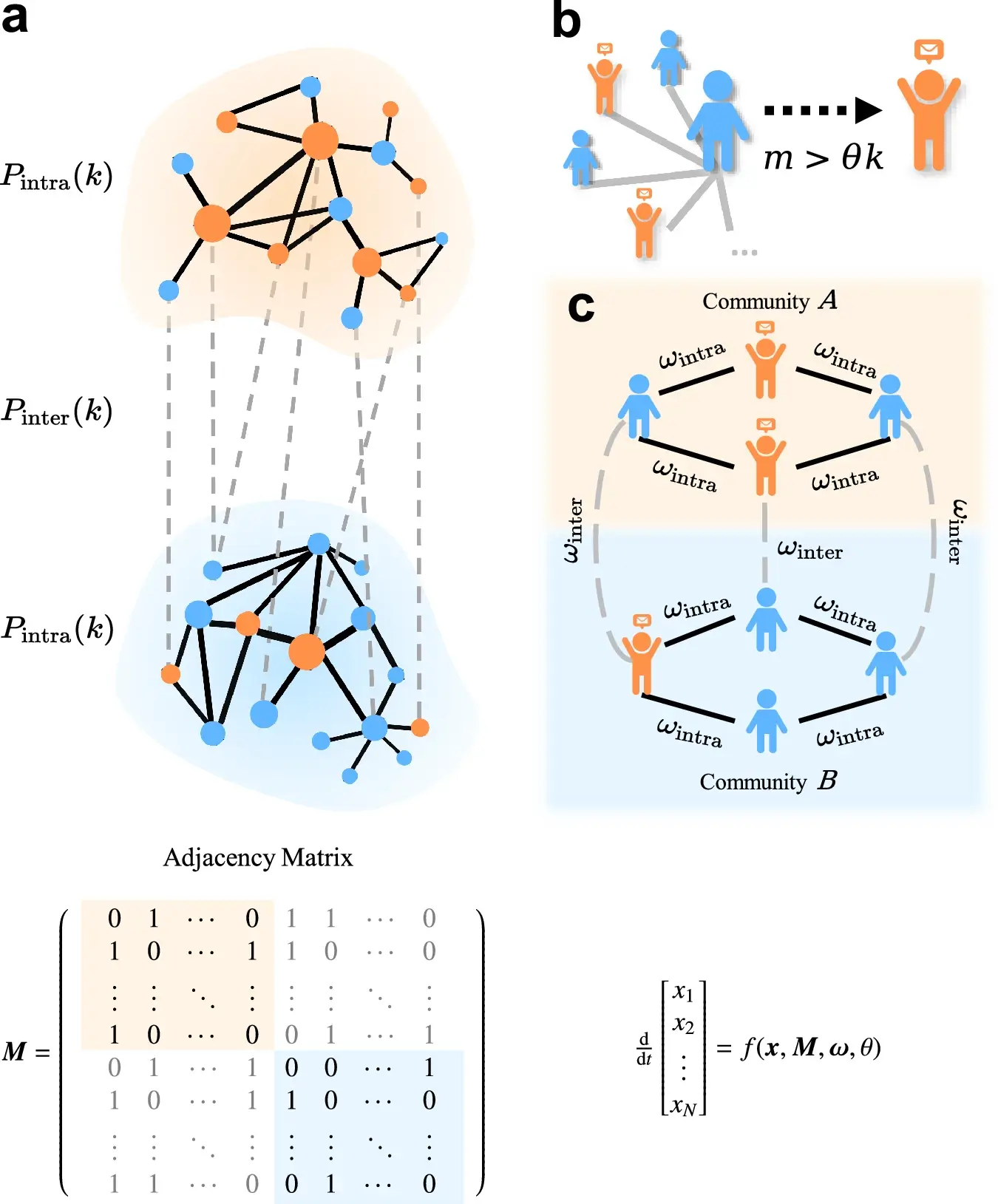
Social platforms, public communication systems, and collective-behavior networks often have pronounced community structure: interactions are dense within communities and sparse across community boundaries. Whether information remains local or spreads globally depends not only on the network topology, but also on how transmission is regulated within and across communities.
In Nature Communications, Jingfang Fan and collaborators published Community structure-regulation coupling reveals optimal information diffusion. The study develops COSREF, a community structure-regulation coupling framework that integrates multicommunity network structure with process-level regulation of information transmission.
Research Question
Many studies of spreading processes focus either on network topology or on intervention strength. Real information systems, however, rarely regulate all transmission channels uniformly. Within-community and cross-community diffusion can be promoted or suppressed in different ways.
The paper asks three connected questions:
What macroscopic diffusion states emerge when community structure and regulation strength vary together?
Is there a low-cost domain where small targeted interventions can prevent global spreading?
Does stronger community structure always reduce the cost of intervention?
The COSREF Framework
COSREF divides a network into multiple communities and introduces separate regulatory effects on within-community and cross-community transmission. This creates a coupled structure-process system in which topology and regulation jointly determine diffusion outcomes.
The framework makes it possible to analyze:
how within-community links sustain local diffusion;
how cross-community links trigger global spreading;
how regulation parameters reshape critical boundaries;
how community strength changes the cost of containment.
Three Macroscopic Diffusion States
The study identifies three characteristic regimes:
No diffusion: information cannot sustain spreading even locally.
Localized diffusion: information spreads inside some communities but does not become system-wide.
Global diffusion: information crosses community boundaries and propagates across the network.
These regimes are separated by abrupt transition boundaries. By mapping the associated critical phase diagram, the work moves beyond a binary question of whether diffusion occurs and instead characterizes which combinations of structure and regulation lead to each state.
Optimal Intervention Domain
A central result is the identification of a low-cost intervention domain. Fully suppressing every transmission channel can contain spreading, but it is expensive. Regulating only cross-community transmission may also be insufficient if local spreading remains stable.
COSREF shows that within-community and cross-community regulation can cooperate: a small, targeted change in transmission parameters can prevent localized diffusion from becoming global diffusion. This cooperative region corresponds to an efficient intervention domain.
The paper also finds that the optimal intervention cost depends nonmonotonically on community strength. When community structure is weak, information can move easily across the whole network. When it is too strong, local spreading can persist inside communities. At intermediate community strength, structural barriers and regulatory control interact more efficiently.
Validation on Real Networks
Beyond theory and simulations, the study tests COSREF on large real social networks. The results reproduce the three diffusion states, the critical transitions, and the low-cost intervention region across different topologies, supporting the robustness of the framework for real information environments.
Why It Matters
This work places community structure and transmission regulation in a single theoretical framework. Network topology alone does not determine diffusion outcomes, and regulation is not simply an external control applied after the fact. Their coupling shapes whether information remains local or becomes global.
For complex-systems research, COSREF offers a transferable lesson: in modular systems, optimal control may come not from maximum intervention strength, but from coordinated adjustment of structural boundaries and dynamical parameters.
Paper Information
Paper: Community structure-regulation coupling reveals optimal information diffusion
Authors: Xiaojie Chen, Meiling Xie, Jun Meng, Sheng Fang, Xiaosong Chen, Jürgen Kurths, Jan Nagler, Jingfang Fan